A client recently told me that she had spent one afternoon the previous weekend not thinking about her late mum. It had really taken her by surprise when she noticed afterwards. Those few hours had been spent going about her day – having coffee with a friend, doing some food shopping, listening to a podcast. When eventually thoughts about her mum did pop back up – she felt an intense pang of guilt. How could she have forgotten? She’d only been gone a few short months! It felt like a betrayal to her mum’s memory.
The Dual Process Model of Grief, put forward by Stroebe and Schut in 1995, highlights the importance of my client’s experience. It suggests that in the wake of a significant loss or bereavement, our world consists of two parts; the part where our thoughts and activities are loss-oriented, and the part where they are restoration-oriented. Loss-oriented activities include thinking about the person we’ve lost, looking at photos of them, listening to songs that remind us of them, talking about our loss, crying, writing – anything that involves acknowledging and experiencing our grief. Restoration-oriented activities include going back to work, seeing friends, dealing with new responsibilities, taking up or restarting a hobby – anything that involves rebuilding life after a loss.
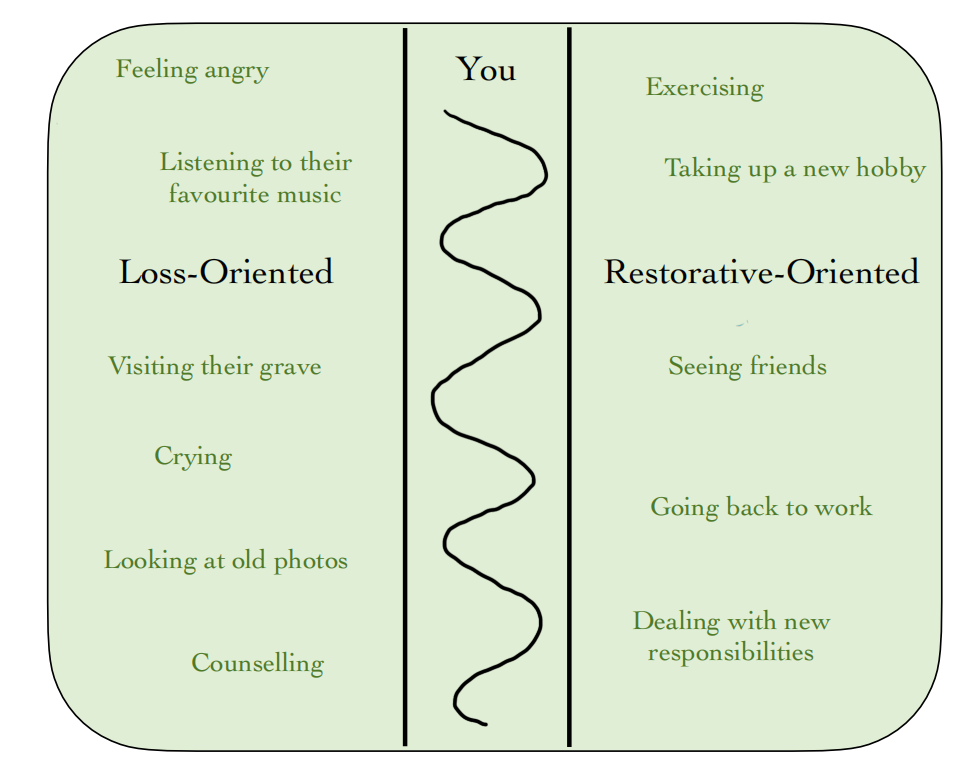
Now, as I’ve mentioned before, everyone’s grief journey looks different, and there is no ‘right way to grieve.’ Many people spend weeks, months or years predominantly in the loss-oriented part of life, while some dive straight into restoration. For some this is intentional – a choice they’ve made based on upbringing, culture or how they think grief should be. For others, it can be more instinctive or involuntary. It can bring about feelings of guilt or worry that you are spending too much time grieving – or not enough! Or confusion that other people are grieving differently to you, based on how much time they are spending in loss or restoration. An awareness of this model shows us that both parts are important in our grief. In order to cope with the demands of life and also heal and move forward, spending time in both parts is necessary, and a lot of people naturally oscillate between the two.
I like to use this model with clients by asking them to consider how much time they spend in each part, and what activities they engage in. I invite you to do the same. Try to do this with self-compassion – you are not doing anything ‘wrong!’ However, if you recognise a tendency in yourself to be fully in the loss-oriented part of the model, it might be helpful to think of something you can do today or this week that is restorative. Something small and manageable. In the same way, if you notice that you are firmly in the restorative part, what can you do to today to spend a little time in your grief? What feels achievable for you? By engaging with both parts, you may find moving forward that little bit easier.